
How I Work
TLDR: In most cases, I use my own photos as reference material, but will use owners’ photos for pet portraits. No generative AI is used at any stage. I draw portraits by hand, typically on cotton paper, using lightfast pencils.
Photography
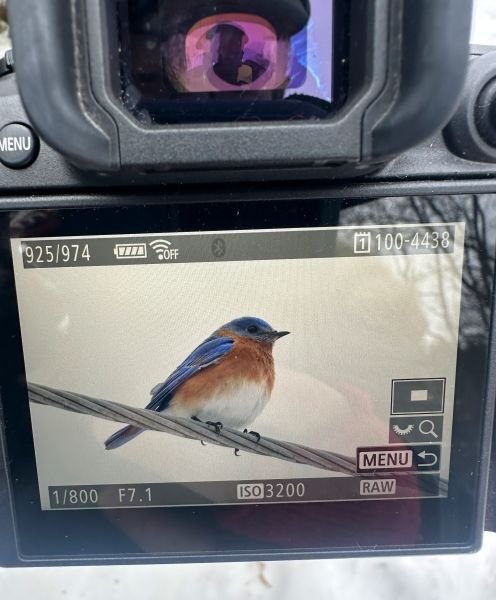
No wild animal will pose for 40 hours. To draw a realistic portrait, I depend on highly detailed photographs.
Most days, I go out with my camera into a local ravine — usually in the morning light. I typically use a 100-500 mm lens, sometimes with a 1.4x extender. I take the wellbeing of my subjects to heart: e.g., I don’t bait owls or feed coyotes; I try to respect the animals’ space and get images of them doing their own thing. Ideally, I am far enough away for them not to care about me.
I often take hundreds of photos within a couple of hours.
At home, I sort through the images, discarding most. If there’s an image that needs editing — e.g., if the shadows are too dark — I pull it into Lightroom.
The only use I make of AI is to put a mask on an area that I want to edit — because it’s faster than brushing it. I never use generative AI.
For pet portraits, I usually ask owners to send me their own photos. For wildlife, on occasion, I will use another photographer’s work as reference, but only where copyright is freely given or where I can purchase a licence. In such cases, I give credit.


Composition
A portrait can be simple … or not. Much depends on the background: Plain white? Blurred leaves? Detailed branches? I seldom use a single photo as a reference. I often cut out shapes and move them around on my desk, or draw quick sketches to visualize the layout. Once I’ve decided on the overall shape of the picture, I draw simple outlines of each element, sometimes using a light table to ensure (for example) that I’ve got the eye in the right place. I then transfer these outlines to the drawing surface. I.e., I use a combination of freehand drawing and tracing at this stage.
Drawing
Once I’m happy with the basic outline (I use a small ruler and putty eraser a lot at this stage) I get to add the colour. This is the stage that takes the most time — often 40+ hours. The pencils I use are semi-translucent. Colour shows through each layer. Most areas of the drawing are built up of many layers to get the right texture and hue and value. All of my drawing at this stage is freehand. I look back and forth between my reference photos and the drawing surface. The goal is not to get the drawing to look “just like the photo”. It is to make a portrait that is even better than a photo!
Materials
I use artist-grade pencils that are highly rated for lightfastness to ensure that the colours stay true for many years to come. The brand I use most often is Faber-Castell (Polychromos) but I also use Caran d’Ache (Luminance/Pablo), Derwent (Lightfast/Drawing), and occasionally Holbein (Artist).
Sometimes I add another medium, such as watercolour paints or oil pastels. Again, I use only artist-grade, lightfast options.
My current favourite paper is Fabriano Artistico’s hot pressed paper (640 gsm) which is 100% cotton and acid-free. I use this for most drawings. But I sometimes use other papers, or Pastelmat, or drafting film. All of these are archival: i.e., longlasting and acid-free.

Copyright is owned by Megan O’Connor